

Trade in Europa Universalis 5 isn’t just about making money, it’s the lifeblood that keeps your nation breathing. This Eu5 Trade Guide breaks down everything from Trade Advantage and Markets to the complete goods system, giving you the knowledge to dominate trade networks and fill your coffers with ducats.
Table of Contents
Understanding Trade in Europa Universalis 5
Unlike previous Europa Universalis games, EU5 simulates actual goods flowing between dynamic markets that expand and contract based on economic forces.
The profit from any trade comes down to price differences between markets. If wine sells for 2 ducats in your home market but fetches 4 ducats in a distant market, that 2 ducat difference is your profit margin before accounting for transportation costs and tolls. Distance matters because moving goods across long trade routes eats into your margins, and passing through territories with trade tolls like the Sound Toll at Kronborg Castle will reduce your earnings even further.
Trade Advantage
Trade Advantage determines who gets first pick of goods in any given market. Think of it like standing in line at a store during a limited sale, the person at the front gets the best selection while those at the back get whatever’s left. Nations with the highest Trade Advantage in a market secure first access to export the most profitable goods, while nations with low advantage are stuck with scraps.

Building Trade Advantage involves several strategies. Marketplaces are your primary tool, with each building increasing both Trade Capacity and Trade Advantage. Maritime presence also contributes to your advantage in coastal markets, making naval investments pay dividends beyond military power. Trade Offices in foreign territories give you a foothold in distant markets once you have positive relations above 100 with that nation.
Eu5 Markets
Markets are economic zones where multiple nations buy and sell goods through a central hub called a Market Center. Locations in EU5 exclusively trade with their assigned market based on competing forces of Market Attraction and Market Protection. Market Attraction represents how strongly a market center pulls nearby locations into its economic orbit, scaling with prestige, development, and trade profitability.
Locations far from their market center suffer reduced market access, which directly lowers building output and available goods. This Eu5 Trade Guide recommends building roads to connect distant territories to your market centers, as transportation infrastructure directly improves Market Access.
The nation owning a market center gains substantial bonuses including increased institution growth, higher trade advantage, additional supported building levels, and expanded stockpile capacity. You also unlock the ability to embargo other nations in that market, preventing them from establishing new trade routes though this tanks your relations by 25 opinion.
Eu5 Trade Capacity
Trade Capacity represents the volume of goods you can import and export within each market. Every trade route you establish consumes one point of Trade Capacity, so a nation with 10 capacity in the Genoa market can maintain 10 simultaneous import or export agreements there.
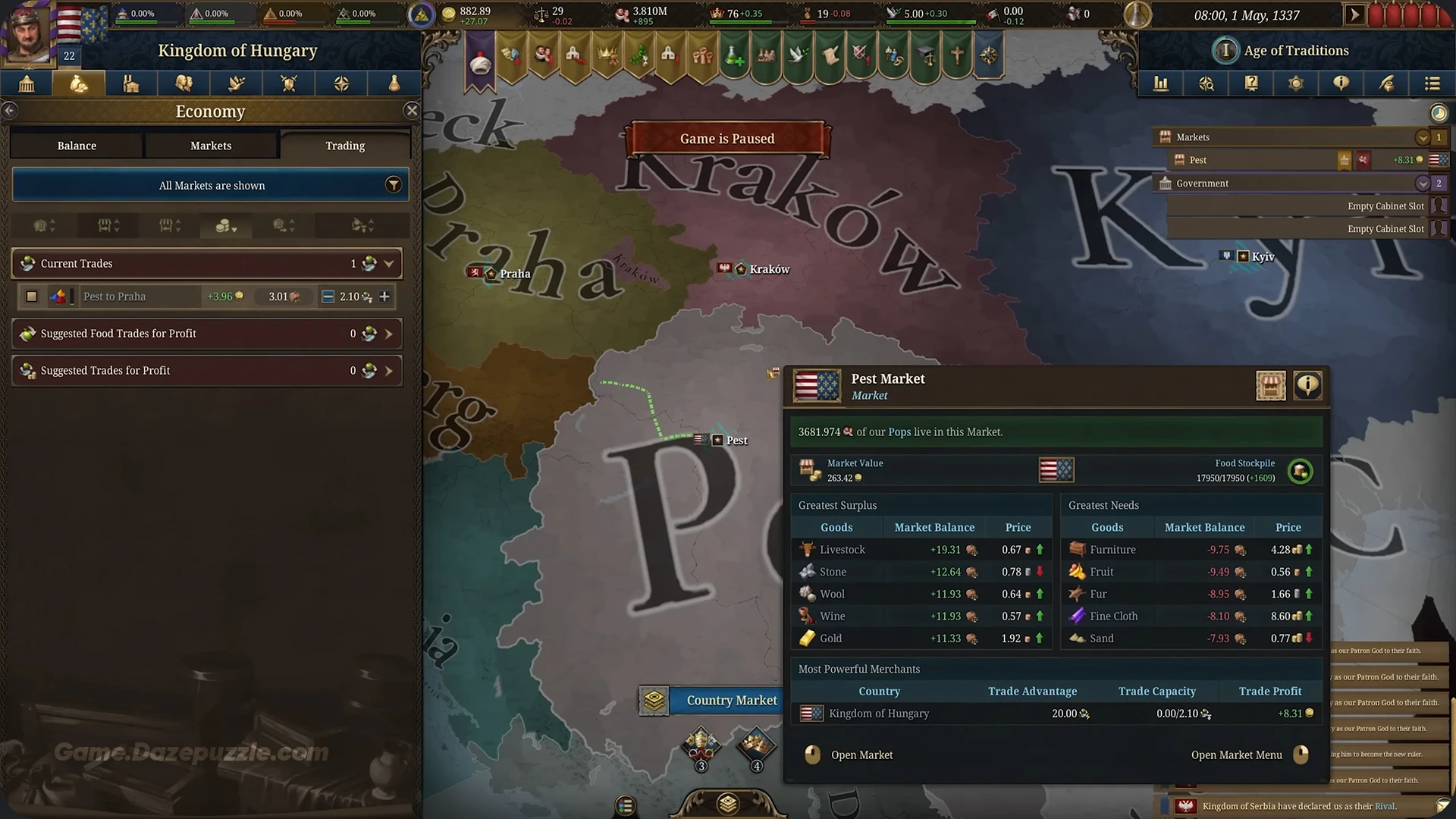
The Burgher estate also conducts independent trade using their own capacity, moving goods to alleviate shortages in their locations. The size of your Burgher population determines how much autonomous trading they perform, which can help stabilize your economy by filling gaps you have not addressed.
How to Increase Trade Capacity in Eu5
Marketplaces remain your most reliable method for increasing Trade Capacity, with each building providing +1 capacity in its market. Since Marketplaces also boost Trade Advantage, they deliver double value and should be among your first building priorities. Wharfs serve as the coastal equivalent, providing both Trade Capacity and reducing proximity costs through harbor improvements.
Government reforms and technological advances periodically unlock bonuses to Trade Capacity. Estate privileges offer another avenue, with the Burgher Trade Monopolies privilege increasing Burgher-driven trade but reducing your nation’s Trade Capacity. Use this privilege when you have surplus capacity and want to automate economic management.
If you are looking for a complete guide for Economy in EU5, Read our Europa Universalis 5 Economy Guide
Trade Goods Map
Goods in EU5 are distributed geographically based on historical accuracy and climate. Certain resources only exist in specific regions of the world at game start, creating natural monopolies that drive trade patterns.
| Region | Exclusive/Primary Goods |
|---|---|
| Southeast Asia (Moluccas) | Cloves, Pepper, Spices |
| Central & South America | Cocoa, Chili, Maize, Potatoes, Tobacco |
| Sub-Saharan Africa | Gold (Mali), Ivory, Slaves |
| India & East Asia | Silk, Tea, Porcelain, Lacquerware, Cotton |
| Middle East & Arabia | Incense, Coffee, Dyes |
| Northern Europe (Baltic) | Amber, Fur, Naval Supplies, Lumber |
| Mediterranean | Wine, Olives, Marble |
| Central Europe (Bohemia) | Silver (Kutna Hora), Copper |
Cloves deserve special attention because they only exist in Southeast Asia at game start, making the Moluccas extraordinarily valuable. Similarly, cocoa and chili are New World exclusives that become available only after European contact with the Americas.
Trade Goods List
Raw Goods are extracted directly from locations through Resource Gathering Operations. Produced Goods require buildings with specific inputs to manufacture, representing more complex production chains.
Essential Raw Materials
| Good | Type | Default Price | Transport Cost | Key Uses |
|---|---|---|---|---|
| Iron | Mining | 3 | 1 | Tools, Steel, Weaponry production |
| Copper | Mining | 3 | 2 | Cannon production, Bronze alloys |
| Coal | Mining | 2 | 2 | Industrial buildings, Steam power |
| Saltpeter | Mining | 2 | 1 | Gunpowder, Firearms, Artillery |
| Lead | Mining | 2 | 2 | Firearms ammunition, Books |
| Lumber | Logging | 1.5 | 1 | Construction, Naval Supplies, Paper |
| Stone | Mining | 1 | 5 | Construction, Masonry |
| Clay | Gathering | 0.5 | 1 | Pottery, Construction |
| Sand | Gathering | 0.5 | 1 | Glass production |
| Mercury | Mining | 3 | 1 | Medicine, Gold/Silver refining |
| Tin | Mining | 2 | 2 | Bronze alloys, Pewter |
| Alum | Mining | 3 | 1 | Dye-making, Tanning |
Luxury Trade Goods
| Good | Type | Default Price | Transport Cost | Primary Pop Demands |
|---|---|---|---|---|
| Silk | Farming | 4 | 1 | Nobles, Burghers |
| Cloves | Farming | 5 | 0.5 | Nobles, Clergy, Burghers |
| Pepper | Farming | 5 | 0.5 | Nobles, Clergy, Burghers |
| Chili | Farming | 5 | 0.5 | Nobles, Clergy, Burghers |
| Saffron | Farming | 5 | 0.5 | Nobles, Clergy, Burghers |
| Gold | Mining | 10 | 1 | Nobles (Currency) |
| Silver | Mining | 8 | 1 | Nobles (Currency) |
| Gems | Mining | 4 | 0.5 | Nobles |
| Pearls | Gathering | 4 | 1 | Nobles, Burghers |
| Ivory | Hunting | 4 | 1 | Nobles |
| Amber | Gathering | 4 | 1 | Nobles, Burghers |
| Marble | Mining | 5 | 1 | Nobles |
| Tea | Farming | 3 | 1 | Nobles, Burghers, Clergy |
| Coffee | Farming | 3 | 1 | Nobles, Soldiers, Burghers |
| Cocoa | Farming | 4 | 1 | Nobles, Clergy, Burghers |
| Sugar | Farming | 3 | 1 | Nobles, Clergy, Burghers |
| Tobacco | Farming | 3 | 1 | Nobles, Clergy, Burghers |
| Incense | Farming | 2.5 | 0.5 | Clergy |
| Dyes | Farming | 4 | 0.5 | Building inputs |
Food Raw Materials
| Good | Type | Food Value | Default Price | Transport Cost |
|---|---|---|---|---|
| Wheat | Farming | 8.0 | 1 | 1 |
| Rice | Farming | 10.0 | 1 | 1 |
| Maize | Farming | 8.0 | 1 | 1 |
| Potatoes | Farming | 8.0 | 1 | 1 |
| Sturdy Grains | Farming | 5.0 | 1 | 1 |
| Legumes | Farming | 5.0 | 1 | 0.5 |
| Livestock | Farming | 8.0 | 1.5 | 1 |
| Fish | Gathering | 5.0 | 1 | 1 |
| Fruit | Farming | 4.0 | 1 | 1 |
| Olives | Farming | 4.0 | 1 | 1 |
| Wild Game | Hunting | 3.5 | 1 | 1 |
| Beeswax | Farming | 2.5 | 2 | 1 |
| Fur | Hunting | 2.0 | 2 | 1 |
| Wool | Farming | 5.0 | 2.5 | 1 |
Strategic & Military Goods
| Good | Type | Default Price | Transport Cost | Key Uses |
|---|---|---|---|---|
| Horses | Farming | 3 | 2 | Cavalry, Noble demands |
| Elephants | Farming | 10 | 5 | War elephants, Nobles |
| Cotton | Farming | 3 | 1 | Cloth production |
| Fiber Crops | Farming | 2 | 1 | Textiles, Naval Supplies |
| Salt | Gathering | 4 | 1 | Food preservation, Nobles |
| Wine | Farming | 2 | 1 | All pops demand |
| Medicaments | Gathering | 1 | 0.5 | Healthcare, All pops |
Key Produced Goods
| Good | Default Price | Transport Cost | Primary Inputs |
|---|---|---|---|
| Tools | 3 | 1 | Iron |
| Steel | 5 | 2 | Iron, Coal |
| Weaponry | 3 | 1 | Iron, Steel |
| Firearms | 3 | 1 | Iron, Lead, Saltpeter |
| Cannon | 4 | 1.5 | Copper, Iron |
| Cloth | 3 | 1 | Wool, Cotton, Fiber Crops |
| Fine Cloth | 6 | 1 | Silk, Dyes, Cotton |
| Books | 5 | 1 | Paper, Lead, Dyes, Lumber |
| Paper | 2 | 1 | Lumber |
| Naval Supplies | 3 | 1 | Lumber, Tar |
| Tar | 2 | 1 | Lumber |
| Glass | 2 | 0.5 | Sand |
| Pottery | 1 | 1 | Clay |
| Porcelain | 3 | 0.5 | Clay |
| Lacquerware | 5 | 1 | Resin, Wax |
| Jewelry | 5 | 0.5 | Gems, Gold, Silver |
| Leather | 3 | 1 | Livestock |
| Furniture | 3 | 1 | Lumber |
| Masonry | 1 | 1 | Stone, Clay |
| Beer | 2 | 1 | Wheat, Sturdy Grains |
| Liquor | 2.5 | 1 | Various crops |
| Slaves | 3 | 1 | N/A (captured population) |
This Eu5 Trade Guide emphasizes understanding the production chains connecting raw materials to finished goods. Missing any link in the chain forces you to import either the finished good or the missing inputs through trade.
Eu5 Trade Tips
Start by automating your trade while learning the system. The automation slider lets you delegate trade decisions to the AI, which is surprisingly competent at identifying profitable routes. You can set partial automation, letting the AI handle some trades while you manually select others.
Focus on production chains within your territory rather than importing expensive raw materials. If you control iron mines and have coal deposits, building domestic steel production is far more profitable than importing steel. Complete production chains keep profits within your economy and reduce dependency on unreliable trade partners.
Crown Power directly determines how much trade income reaches your treasury versus being captured by estates. Raising Crown Power through legitimacy, reforms, and laws should be a constant priority because it multiplies the effectiveness of all your trading efforts. Sometimes trading at a loss makes strategic sense if your buildings are not receiving critical input goods, check your population needs notifications to identify shortages and prioritize importing those even if the immediate profit is negative.
Europa Universalis V Steam Page
Thanks for Staying with Game.Dazepuzzle